Showing posts with label Indian Coins. Show all posts

British India 1/4 Rupee Silver Coin 1943 King George VI

Coins of British India 1/4 Rupee Silver Coin 1943 King George VICoins of British India 1/4 Rupee Silver Coin

Coins of British India 1/4 Rupee Silver Coin 1943 King George VI

Obverse: Crowned head of King George VI facing left, English legend, toothed rim.
Lettering: GEORGE VI KING EMPEROR.
Engraver: Percy Metcalfe.

Reverse: Within circle, date divides legend in English & Urdu (Chaar Aana). Outside circle, wreath made of roses, thistle, shamrock leaves and lotus flowers. All within a toothed border.

Lettering: 1/4 RUPEE INDIA 1943 چار آنہ.
Translation: Urdu: 4 annas (= 1/4 rupee).


Coins of British India 1/2 Pice 1853

Coins of British IndiaCoins of British India 1/2 Pice 1853

Coins of British India 1/2 Pice 1853

Obverse: Queen Victoria - Coat of arms of the East India Company: 2 lions, St George's cross on the crest and flags, motto on the ribbon "AUSP: REG: SEN: ANG:" ("Auspicio Regis et Senatus Angliae")
Lettering: 1853 AUSP: REG: SEN: ANG:
Translation: By the Command of the King and Parliament of England

Reverse: The value within a laurel wreath:1/2 PICE Around this is the legend:EAST INDIA COMPANY Within a plain, raised rim.
Lettering: EAST INDIA COMPANY ½ PICE
Edge Plain

Comments:
- Minor variations occur in date numerals
- In 1848, in response to the Court of Directors request that copper coin be superseded by silver fractions of a rupee, the Government of India produced a report that included, inter alia, reference to the fact that cowrie shells still passed current for small purchases in Bengal. The Directors, having read this report, then revised their earlier view and suggested that a further copper denomination of half pice should be added to the coinage for use in Bengal. The Government of India agreed to this and coinage started at the Calcutta mint in 1853, which is the fixed date shown on the obverse of the coin.

Value: 1/2 Pice (1/128).
Metal: Copper.
Weight: 3.23 g.
Diameter: 21 mm.
Shape: Round.


Pice - This coin is mentioned in the annals of Bombay as early as the middle of the seventeenth century, and while its value varied to some extent, it was generally accepted as equal to the fourth part of a Fanam. Specimens of Pice, as well as halves and doubles, exist in both copper and lead. In 1835 an Act was passed in the Presidency of Bengal making the Pice legal tender for one sixty-fourth of the East India Company Rupee. The copper Pice of today retains this ratio and is divided into three Pies.
  Amoug the varieties of the Pice formerly current in the Deccan and other Parts of Hindustan, two of the principal ones were known as the Seorai, equal to one sixty-fonrtli of the ("handor Rupee, and the .laniodi or Siahi, equivalent to one tifty-sixth of a British Rupee. See Paisa. The Gazetteer of Aurangabad. 1884. cites the following in reference to the coins of the Deccan :
  "The copper coins that prevailed were the Seorai, Jamodi, Dhabbu, and Siahi.
The Seorai-pice weighed 11 1/2 mashas, equal to 172 1/2 grains troy, and 16 gaudus of them, riz. 64, were given in exchange for a Chandor Rupee. The Jamodi, or Siahi-pices, were exchanged at the rate of 14 gandas, riz. 56, for a Surti or British Rupee. The Dhabbu weighed 18 mashas, equal to 270 grains troy, and was exchange at 8 gaudas, viz. 32, for a Chandor Rupee. The Siahi and Dhabbu are still sparingly current."

East India Company One Mohur Gold Coin 1841 Victoria Queen

East India Company Mohur Gold Coin Victoria QueenEast India Company Mohur Gold Coin 1841 Lion Palm Tree

East India Company One Mohur Gold Coin 1841 Victoria Queen
Issued by East India Company, 1841-1850 Minted by Madras Mint

Obverse: Head of the Queen facing left; around above, VICTORIA QUEEN; below, 1841.
Reverse: A lion advancing to left in front of a palm tree; around above, EAST INDIA COMPANY; in exergue, ONE MOHUR and a line in Persian script (yek ashrafi; translation: one mohur)
Edge: Milled (vertical)

This gold mohur continues the tradition of its predecessor (the mohur of William IIII which bore the frozen date 1835). Now showing the head of Queen Victoria, the new coins bear the frozen date 1841 and were not legal tender. Legal tender was the silver rupee, the value of the gold mohur in rupees varied with the relative market prices of gold and silver. However, from 13 January 1841 Treasuries were ordered to accept the mohur at the original 1835 fixed rate of 15 rupees.

Dimensions: 26 mm (Diameter)
Weight: 11.661 g (Weight)


British India Coins


British India Coins, Madras Presidency 5 Rupees or 1/3 Mohur 1820

British India Coins East India Company Madras Presidency 5 Rupees MohurMadras Presidency 5 Rupees or Mohur

British India Coins, Madras Presidency 5 Rupees or 1/3 Mohur 1820 Issued by East India Company, Minted by Madras Mint

Obverse: Arms of the Company; around, ENGLISH EAST INDIA COMPANY
Reverse: Legend in Persian (translation: Five Rupees of the Honourable English Company)
Edge Description: Milled

The East India Company obtained permission to strike Arkat style rupees from the Subah of Arkat (Arcot) in 1742. The first actual production was in 1759 in the name of Alamgir II and bear the Hegira date 1172 with the regnal year 6. Machine struck gold rupees (valued at 15 silver rupees) and their fractions were produced in 1817 with the same designs on obverse and reverse as the silver. Those coins were replaced in 1819 by types, having the same standard and weight, but bearing the Company arms or crest, because the use of the same designs on silver and gold coins of about the same size had led to the silver pieces being gilded and passed as gold. This was a new denomination introduced at that time and giving a better exchange between silver and gold; 5 rupees or 1/3 mohur.

Dimensions: 19.5 mm
Weight:    3.85 g


British India Coins


British India Coins, Madras Presidency Half Pagoda 1808-1811

British India Coins Madras Presidency Half PagodaIndia Coins Madras Presidency 1/2 Pagoda

British India Coins, Madras Presidency Half Pagoda 1808-1811, 1/2 Pagoda 2nd series Minted by Madras Mint.
Overstruck on plug from a Spanish-American 8 Real of Carlos IIII (1788-1807)

Obverse: At centre a temple tower (gopura) surrounder by stars; around on an buckled garter, HALF PAGODA (the first three letters of HALF have not removed the HIS of HISPANIA from the original coin)
Reverse: At centre within circles of beads, the Hindu God Vishnu; around on a ribbon with its ends seperated by a star, the denomination in Telugu and Tamil (the first characters of the Tegulu have not removed the S IIII of CAROLUS IIII from the original coin)
Edge Description: Milled ///

Silver coins struck on the pagoda standard were authorised in July 1807. The coins were struck from silver obtained from Spanish dollars (this coin shows some of the original Spanish lettering). In 1808 the dumpy style gold star pagoda was replaced by flat European style gold coins and the initial silver series was re-designed to this form to closer match the new gold pieces. Production continued until June 1812 when dissatisfaction with the complex pagoda and Arkat rupee based coinages led to a Proclamation stopping production of, but permitting the continued circulation of the pagoda based pieces. A new rupee standard was introduced in January 1818 producing a standardised coinage.

Dimensions: 36 mm (Diameter)
Weight:         21.34 g (Weight)


British India Coins


British India Madras Presidency Gold Mohur Coin 1819

Ashrafi Mohur Gold Coin British East India Company coinsBritish India Gold Mohur Coin 1819
British India Madras Presidency Gold Mohur Coin 1819
Ashrafi or Mohur (Muhr), Issued by East India Company, Madras Presidency, India, 1819 Minted by Madras Mint

Obverse: Lions supporting coat of arms of the East India Company; Large letters in legend: ENGLISH EAST INDIA COMPANY; Banner with motto and date below.
Banner: AUSP : REGIS & SENAT ANGLIAE: ("Under the auspices of the king and senate of England!")
Reverse: Legend in Persian (translation: Ashrafi of the Honourable English Company)

The East India Company obtained permission to strike Arkat style rupees from the Subah of Arkat (Arcot) in 1742. The first actual production was in 1759 in the name of Alamgir II and bear the Hegira date 1172 with the regnal year 6. Machine struck gold rupees (valued at 15 silver rupees) were produced in 1817 with the same designs on obverse and reverse as the silver. Those coins were replaced in 1819 by this type, having the same standard and weight, but bearing the Company arms, because the use of the same designs on silver and gold coins of about the same size had led to the silver pieces being gilded and passed as gold.

Dimensions: 28 mm
Weight: 11.66 g

British India Coins


One Mohur of Queen Victoria of 15 Rupees 1862

India Gold Mohur of Queen Victoria 15 Rupees coinGold Coins British India Mohur 15 Rupees 1862
Gold Coins of British India 
One Mohur of Queen Victoria of 15 Rupees 1862

One Mohur of Queen Victoria, 1862.
Obverse: Crowned bust of Queen Victoria. Legend: "VICTORIA QUEEN."

Reverse : " ONE MOHUR " " INDIA ; " and below, the date of the year of issue, the whole in four lines occupying the field, surrounded by a circle of dots and fancy arabesques.
Weight : 180 grains. Fineness: 916.666.

Gold Coins of British India - Imperial coinage
Victoria Queen and Empress

After the Indian Mutiny of 1857–58, the administration of British India was transferred from the East India Company to the British Crown. From 1862 till Indian independence in 1947, circulation coins were minted under the direct authority of the Crown. The early imperial issued coins continued to bear a fixed date, for example, rupee coins with the year 1862. This practice was intended to discourage the prevalent 'batta' system, i.e., a heavy penalty imposed by money changers or 'shroffs' on coins bearing an older date to account for wear and weight loss, irrespective of the actual condition of the coin.

Early gold coinage with Queen Victoria's crowned bust consisted of one mohur coins dated 1862. These coins were of the same weight (11.66 grams = one Tola) and fineness (0.9167) as the East India Company issued mohurs. These coins, probably minted between 1866 to 1869, were trade coinage and not recognized as legal tender. A number of varieties (including proofs) are known with minor variations in the reverse and obverse decoration details. 'Victoria Queen' mohurs were also struck with the year 1875, as well as 1870 proof issues with a mature bust of Victoria.

In 1876, Victoria assumed the title of 'Empress of India' and, from 1877, the legend on the obverse of all coins was changed to 'Victoria Empress'. Gold mohurs with the new obverse legend were issued between 1877 and 1891. The mintage of these mohurs is for any given date is relatively low, making them considerably scarce. Fractional values of the mohur (nominally valued at fifteen silver rupees) were also struck in denominations of ten and five rupees between 1870 and 1879. Except for a small number of ten and five rupees dated 1870, most of the fractional mohurs were proof issues. Varieties with both the younger and mature busts exist.

Mohur

The word 'Mohur' or 'Mohor' is the Persian word muhr, which means 'seal' and is cognate with the Sanskrit word mudra which also means 'seal.'

A Mohur is a gold coin that was formerly minted by several governments, including British India and some of the Princely States which existed alongside it, the Mughal Empire, Nepal, and Afghanistan. It was usually equivalent in value to fifteen silver rupees. It was last minted in British India in 1918, but some princely states continued to issue the coins until their accession to India after 1947. Similar coins were also issued by the British authorities in denominations of 2/3 Mohur (10 Rupees), 1/3 Mohur (5 Rupees) and the double Mohur (30 rupees), and some of the Princely States issued Half Mohur coins (equal to 7 Rupees and 8 Anna).

The Mohur coin was first introduced by Sher Shah Suri during his rule in India between 1540 and 1545 and was then a gold coin weighing 169 grains (=10.95 grams). He also introduced copper coins called Dam and silver coins called Rupiya that weighed 178 grains (=11.53 grams). Later on, the Mughal Emperors standardized this coinage of tri-metallism across the sub-continent in order to consolidate the monetary system.

Queen Victoria Coins


Hyder Ali gold mohur estimated at $25,500 ahead of London sale

India gold mohur
The gold mohur was issued under the reign of Hyder Ali, father of Tipu Sultan
A gold mohur minted in Mysore under the reign of Hyder Ali in the mid to late 1700s is the star lot of Baldwin's Indian Coins auction in London on May 8.
Ali ruled a large swathe of southern India from 1761 to 1782, putting up a strong fight against the encroachments of the East India Company.
He was succeeded by his son, Tipu Sultan (the Tiger of Mysore), whose defeat at Seringapatam in 1799 spelled the end for Indian independence in the colonial era.

The coin was struck soon after Ali's forces took the kingdom of Bednur during his northern campaign and is one of only a handful of recorded examples.
It carries an estimate of 10,000-15,000 British Pounds (16,861-25,291 US Dollars).
A 14th century gold tanka, minted in Madura in the Tamil Nuda region of India under the rule of Jalal al-Din Ahsan Shah, could make 8,000-10,000 British Pounds (13,488-16,861 US Dollars).
An inscription on the obverse describes Ahsan as "lord of both worlds", a title usually reserved exclusively for Allah, while on the reverse he is named "father of the weak and destitute".
Islam flourished in the region for a brief period before it was crushed by the rise of the Hindu Vijayanagara Empire.
In September last year a gold pagoda coin from the era of Tipu Sultan made $29,000 in Baldwin's high profile sale of the David Fore collection.

British India Coinage one Rupee Silver Coin of 1877, Crowned bust of Queen Victoria "Gothic head", Alwar State.

British India coin Rupee Queen Victoria
British India - Queen Victoria - one Rupee silver coin
British India Rupee silver colonial coin
British India Rupee silver coin
Indian one Rupee Silver Coin, Alwar State, mint date 1877.

 Queen Victoria wear the Imperial State Crown. This is the image of the young Victoria, 1847. It is referred to as the "gothic head".
British colonial coins, Queen Victoria Coins, British coinage, British silver coins, Numismatic Collection, silver coins, old coins, coin collecting, rare coins, world coins, foreign coins, heritage coins, silver ira investment, silver bullion coins, silver coin collection investors, investment coins, antique coins, Unique Silver Coins, collectible coins.


Obverse: Crowned bust of Queen Victoria left, wearing pearl-necklace and Indian dress.
Legend: VICTORIA EMPRESS

Reverse: Legend in three lines (titles of Raja Mangal Singh in Persian script) above date (1877). Sprays at sides.
Legend: ONE RUPEE / ALWAR STATE

Reference: KM-45.
Mint Place: Rajgarh
Mintage: 200,000 pcs.
Weight: 11.59 gram of Sterling Silver (.925)
Diameter: 36 mm

Maharaja Mangal Singh Prabhankar was the 6th Maharaja of Alwar (1874/1892) born 1859, adopted from Thikana Thana, installed upon the gaddi on 14th December 1874, in preference to Kunwar Lakhdir Singh of Bijwar, Maharaja [cr.1889], G.C.S.I., married (amongst others), (a) 1877, the second daughter of Maharaja Prithvi Singhji of Kishangarh, married (b), 1878, a daughter of Raja Bhairon Singhji of Ratlam, and had issue. He died 23rd May 1892 in Nainital due to alcoholic poisoning.


British India Coins


Coins of Portuguese India one Rupia Silver Coin of 1881, King Luis I of Portugal.

Coins monedas Portuguese India Rupia
Índia Portuguesa Rupia
Portuguese India silver Rupee Coin Monedas
Portuguese Indian coin - silver Rupee
World coins - Coins of Portuguese India one Rupia Silver Coin of 1881, King Luis I of Portugal.


Obverse: Head of Luis I of Portugal left. Date (1881) below.
Legend: LUDOVICUS . I . PORTUG : ET . ALGARB : REX . 1881 .

Reverse: Crowned Portuguese shield above wreath.
Legend. INDIA PORTUGUEZA . UMA RUPIA .

Reference: KM-312.
Denomination: Uma Rupia (1 Rupee)
Weight: 11.62 gram of Silver (.917)
Diameter: 30 mm

Portuguese Indian rupia, Coins of Portuguese India, Portuguese India silver coin, Coins of the Portuguese India, Portuguese India colonial coinage, Portuguese India  silver coins, Numismatic Collection, silver coins, old coins, coin collecting, rare coins, world coins, foreign coins, heritage coins, silver ira investment, silver bullion coins, silver coin collection investors, investment coins, antique coins, Unique Silver Coins, collectible coins.


Coins of Portuguese India

 Many coins collectors know about the Portuguese city of Macao, located on the south coast of China, and of the rather extensive series of coins that have been issued for it. But fewer of us know much about what is collectively called Portuguese India.

It took Great Britain lifetimes to pull most of modern day India, Pakistan, Bangladesh and Sri Lanka into its empire. As all that was going on, Portugal managed to keep three small footholds right on the western shores of India proper. This actually reflects something of a very long-term turn of events. You see, in the late 1400s and early 1500s, the Portuguese crown had put quite the effort into logically and systematically getting ships around Africa to India to open a trade route by sea. But the British had been building ships of their own, and with them won the long-haul battle for the land and the wealth of India.

So, while the coins of British India are really pretty easy to collect, and sport a lot of history, they eclipse the Portuguese Indian coins of Damao, Diu and Goa.

The easiest way to dig into the coins of Portuguese India is to start at 1959. Yes, hard though it may be to believe of colonial cities that started in the days of wooden sailing ships, these three cities were still Portuguese in the late 1950s. In a system where 100 centavos were equal to one escudo, there are plenty of denominations, as well as relatively large mintages, from which to choose. The little 10-centavos pieces are even something that can still be found in dealer bargain bins. All are bronze or a copper-nickel alloy, which means they are rather inexpensive today. Even the large 6-escudo pieces don’t cost an arm and a leg. About the only thing a collector will really need in abundance is patience. None of these appear too often, even at large shows.

Stepping back a bit, to the decades from the late 1800s until the early 1950s, Portuguese Indian coins were made in a series that spans from the tiny copper 3 reis coins up to the big, silver uma pieces, also called rupia. Unlike their more modern counterparts, this series has one of those wonderfully non-decimal systems: 1 rupia was equal to 960 reis. It was also equal to 16 tanga. That means 60 reis were also equal to one tanga. Add to all this coins titled “oitavo” (1/8th of a tanga), “oitavo de rupia” (1/8th of a rupia, or 120 reis), and “meia rupia” (half of a rupia), and you get, well, a monetary system that may appear to us as complex as a Rubik’s Cube. But who knows, in a century or so, folks might wonder just what the terms “nickel,” and “dime,” and “quarter” all meant in the United States series.

One great aspect of collecting the coins of Portuguese India for this particular time frame is that the rupias and half rupias were silver. These coins were certainly not issued each year, but from 1881 until the issues of 1935 and 1936, they were still real silver coins. And because so few folks collect them now, they are often priced not too much higher than the price of silver metal on the market.

Collecting these late 19th and early 20th century coins of Portuguese India is not a particularly tough endeavor today. Once again, prices aren’t too high simply because the collector base isn’t too broad. Once more, it’s patience that you’ll need for this hunt.

India Portuguese coins 1/2 Rupee silver coin of 1882, King Luis I of Portugal.

Coins collection Portuguese India Rupee Coin
Índia Portuguesa - 1/2 Rupee Coin
World coins Portuguese India colonial Rupee
Portuguese Indian coin - half Rupee
India Portuguese coins Half Rupee silver coin of 1882, King Luis I of Portugal.
Portuguese Indian rupia, Coins of Portuguese India, Portuguese India silver coin, Coins of the Portuguese India, Portuguese India colonial coinage, Portuguese India  silver coins, Numismatic Collection, silver coins, old coins, coin collecting, rare coins, world coins, foreign coins, heritage coins, silver ira investment, silver bullion coins, silver coin collection investors, investment coins, antique coins, Unique Silver Coins, collectible coins.


Obverse: Head of Luis I of Portugal left. Date (1882) below.
Legend: LUDOVICUS . I . PORTUG : ET . ALGARB : REX . 1882 .

Reverse: Crowned Portuguese shield above wreath.
Legend. INDIA PORTUGUEZA . MEIA DE RUPIA .

Reference: KM-311.
Denomination: Meia Rupia (½ Rupee)
Diameter: 25 mm
Weight: 5.83 gram of Silver (.917)

Portuguese India coins 1/4 Rupee silver coin of 1881, King Luis I of Portugal.

Coins Portuguese India Rupee Colonial Coin
Índia Portuguesa - 1/4 Rupee Coin
World coins pictures Portuguese India Rupee
Portuguese Indian coin - quarter Rupee 
Portuguese India coins Quarter Rupee silver coin of 1881, King Luis I of Portugal.
Portuguese Indian rupia, Coins of Portuguese India, Portuguese India silver coin, Coins of the Portuguese India, Portuguese India colonial coinage, Portuguese India  silver coins, Numismatic Collection, silver coins, old coins, coin collecting, rare coins, world coins, foreign coins, heritage coins, silver ira investment, silver bullion coins, silver coin collection investors, investment coins, antique coins, Unique Silver Coins, collectible coins.


Obverse: Head of Luis I of Portugal left. Date (1881) below.
Legend: LUDOVICUS . I . PORTUG : ET . ALGARB : REX . 1881 .

Reverse: Crowned Portuguese shield above wreath.
Legend. INDIA PORTUGUEZA . QUARTO DE RUPIA .

Reference: Gomes 11.01, KM-310.
Denomination: Quarto Rupia (1/4 Rupee)
Diameter: 19 mm
Weight: 2.89 gram of Silver (.917)

Portuguese India coins 1/8 Rupee silver coin of 1881, King Luis I of Portugal.

Portuguese India Coins Rupee Colonial Coin
Índia Portuguesa - 1/8 Rupee Coin
World coins Portuguese India Rupee coin
Portuguese Indian coin - one eighth Rupee Coin 
Coins World - Portuguese India - one eighth Rupee silver coin of 1881, King Luis I of Portugal.
Portuguese Indian rupia, Coins of Portuguese India, Portuguese India silver coin, Coins of the Portuguese India, Portuguese India colonial coinage, Portuguese India  silver coins, Numismatic Collection, silver coins, old coins, coin collecting, rare coins, world coins, foreign coins, heritage coins, silver ira investment, silver bullion coins, silver coin collection investors, investment coins, antique coins, Unique Silver Coins, collectible coins.


Obverse: Head of Luis I of Portugal left. Date (1881) below.
Legend: LUDOVICUS . I . PORTUG : ET . ALGARB : REX . 1881 .

Reverse: Crowned portugueze shield above wreath.
Legend. INDIA PORTUGUEZA . OITAVO DE RUPIA .

Denomination: Oitavo Rupia (1/8 Rupee)
Diameter: 15 mm
Weight: 1.43 gram of Silver (.917)

World coins India Portuguesa 1/4 Tanga Coin of 1884, King Luis I of Portugal.

Portuguese India Tanga Colonial Coin
Índia Portuguesa - 1/4 Tanga Coin
World coins Portuguese India Tanga Coin
Portuguese Indian coin -  Quarter Tanga Coin
World coins - Portuguese India Quarter Tanga Coin of 1884, King Luis I of Portugal.
Portuguese Indian rupia, Coins of Portuguese India, Portuguese India coin, Coins of the Portuguese India, Portuguese India colonial coinage, Numismatic Collection, old coins, coin collecting, rare coins, world coins, foreign coins, heritage coins, antique coins, collectible coins.


Obverse: Head of Luis I of Portugal left. Date (1884) below.
Legend: LUDOVICUS . I . PORTUG : ET . ALGARB : REX . 1884 .

Reverse: Crown above value in words (QUARTO).
Legend. INDIA PORTUGUEZA . DE TANGA .

Reference: KM-310.
Denomination: Quarto de Tanga (1/4 Tanga)
Material: Copper
Diameter: 25 mm
Weight: 6.53 gm

Portuguese India coins 1/8 Tanga Coin of 1886, King Luis I of Portugal.

Portuguese India Colonial coin Tanga
Índia Portuguesa - 1/8 Tanga Coin
Colonial Coins Portuguese India Tanga
Portuguese Indian coin - one eighth Tanga 
World coins - Portuguese India One Eighth Tanga Coin of 1886, King Luis I of Portugal.
Portuguese Indian rupia, Coins of Portuguese India, Portuguese India coin, Coins of the Portuguese India, Portuguese India colonial coinage, Numismatic Collection, old coins, coin collecting, rare coins, world coins, foreign coins, heritage coins, antique coins, collectible coins.


Obverse: Head of Luis I of Portugal left. Date (1886) below.
Legend: LUDOVICUS . I . PORTUG : ET . ALGARB : REX . 1886 .

Reverse: Crown above value in words (OITAVO).
Legend. INDIA PORTUGUEZA . DE TANGA .

Reference: KM-307.
Denomination: Oitavo de Tanga (1/8 Tanga)
Mintage: 12,397 pcs.
Material: Copper
Diameter: 21 mm
Weight: 3.09 gram

Old Coins of India - Indian Rupee Silver coin issued by Muhammad Ali Shah, King of Awadh, Mint Year 1838.

World coins Indian Rupee Silver coin
World coins - Indian Rupee Silver coin
Coin World Indian silver Rupee
Coin World - Indian Rupee
World coins - Indian Rupee Silver coin issued by Muhammad Ali Shah, King of Awadh, Mint Year 1838 (Reign Year 3).

Obverse: Crown above fish, supported by two figures, which are shouldering scepters. Legends around.
Reverse: Legends in three lines with date (AH 1256) in the middle.

Mint Place: Lucknow
Reference: KM-316.2. R!
Weight: 11.16 gram of Silver
Diameter: 24 mm

Coinage of India Silver Quarter Rupee issued by Ghazi-und-Din Haidar, King of Awadh, Mint Year 1825.

Coinage of India
Coin World - India Silver Quarter Rupee issued by Ghazi-und-Din Haidar, King of Awadh, Mint Year 1825 (Reign Year 7).

Obverse: Crown above Katar dagger, flanked by rampart lions holding flag. Two upright fish flanking regnal year (7) below.
Reverse: Legends in two lines with date (AH124x) in lower right field.

The katar or suwaiya (Tamil: கட்டாரி kaţţāri, Marathi: कट्यार katyaar, Hindi: कटार kaţār, Panjabi: kataa) is a type of push dagger from India. It is characterised by its H-shaped horizontal hand grip, which results in the blade of the sword sitting above the user's knuckles. Unique to South Asia, it is the most famous and characteristic of Indian daggers. Ceremonial katar were also used in worship.

Mint Place: Lucknow
Diameter: 15 mm
Material:
Weight: 2.81 gram of Silver

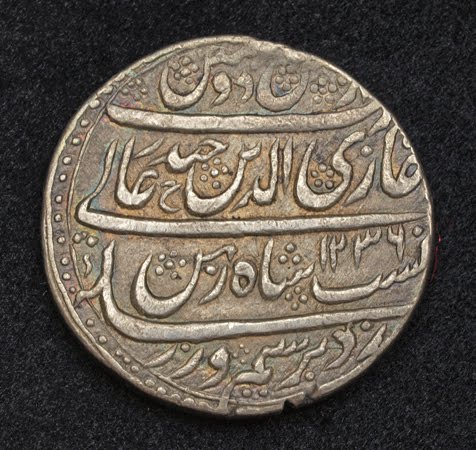
Coins of India Silver Rupee issued by Ghazi-und-Din Haidar, King of Awadh, Mint Year 1820.

India Silver Rupee Coin
Coins of India
World coins India numismatic Silver Rupee
India coin
World coins - India Silver Rupee issued by Ghazi-und-Din Haidar, King of Awadh, Mint Year 1820.

Obverse: Crown above Katar dagger, flanked by rampart lions holding flag. Two upright fish flanking regnal year (7) below. Legends around.
Reverse: Legends in four lines with date (AH 1236) in third field.

Coins of Ghazi-und-Din Haidar

After declaring himself as King, Ghazi-ud-Din Haider issued coins on his name instead of the Mughal emperor, Shah Alam II from AH 1234 (1818). His coins were completely different from his predecessors. The most important feature of his coinage was the introduction of his coat of arms on the reverse of coin, consisting of two fish facing each other, two tigers each holding a pennon for support and a Katar (a small dagger) surmounted by a crown symbolizing the king.

The katar or suwaiya (Tamil: கட்டாரி kaţţāri, Marathi: कट्यार katyaar, Hindi: कटार kaţār, Panjabi: kataa) is a type of push dagger from India. It is characterised by its H-shaped horizontal hand grip, which results in the blade of the sword sitting above the user's knuckles. Unique to South Asia, it is the most famous and characteristic of Indian daggers. Ceremonial katar were also used in worship.

Mint Place: Lucknow
Reference: KM-165.2. R!
Mint Year: 1820 (Reign Year 2)
Weight: 11.09 gram of Silver
Diameter: 25 mm

Coins of India - Silver Rupee coin of 1845 Bombay Presidency, Mughal Emperor Bahadur Shah II, the Last Indian Emperor.

India Silver Rupee coin value
Indian coin - Silver Rupee - Mughal Empire
India Silver Rupee world coin
India Coins - Silver Rupee - Mughal Empire
Coins of India - Silver Rupee coin minted during the reign of the Mughal Emperor Bahadur Shah II - the Last Indian Emperor.

Obverse: Accession date (AH 1215) above Persian inscription couplet ("Shah Alam II...").
Reverse: Persian-julus (formula). Regnal year (46) to right.

Mint Year: 1845 (AH 1215+46)
Mint Place: Calcutta (plain edge)
Diameter: 28 mm
Weight: 11.6 gram of Silver